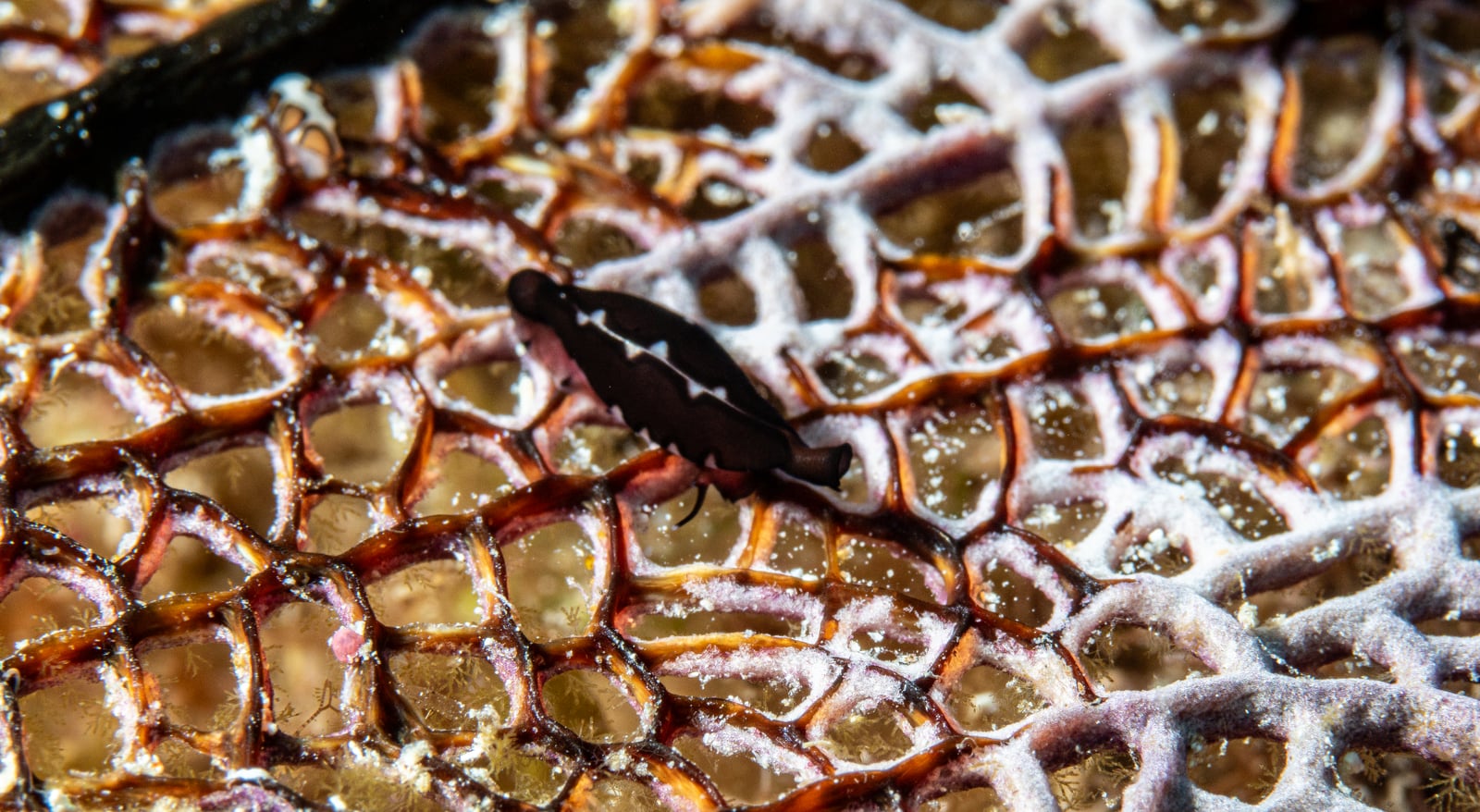
FamilyPlakobranchidaeAlso known assacoglossan nudibranch, solar-powered sea slugDescriptionA small sacoglossan sea slug (likely genus Elysia) perched on a colonial tunicate or bryozoan substrate. These slugs feed by piercing algae or colonial invertebrate cells and sucking out the contents, sometimes retaining chloroplasts for photosynthesis. They are typically small (5–30 mm), cryptically colored to match their substrate, and have a flattened, leaf-like body with parapodia along the sides.HabitatTropical and subtropical shallow reefs and rubble zones, 1–30 m depth; Indo-Pacific and wider warm-water regions; commonly found on encrusting bryozoans, tunicates, and algae.Conservation statusLeast ConcernNotesThe subject is very small and somewhat silhouetted against the brightly-lit colonial tunicate background, making species-level identification to species difficult. The white-edged parapodia visible on the dorsal surface are consistent with several Elysia species. The background substrate appears to be a colonial tunicate (likely Botryllus or Botrylloides sp.) with characteristic reticulate patterning in brown and orange tones with white encrusting coralline algae.Creatures detected3 in frame- sap-sucking sea slug (Elysia sp.)invertebrate
- colonial tunicate (Botryllus/Botrylloides sp.)invertebrate
- encrusting coralline algaeplant_algae